Something To Feed My Brain
I’ve always been a tech guy. I love gadgets and doodads that I can interact with to do something novel. My first console was a hand-me-down Nintendo 64 that I spent thousands of hours playing, and got in trouble for distributing an N64 Emulator from the Computer Lab at school. I had every GameBoy released since the GB Colour, and still have my GBA and GB SP. I’ve been tinkering with home routers for as long as I knew the management IP address and credentials. Most of my birthday presents from my family have been something tech related since the age of 10.
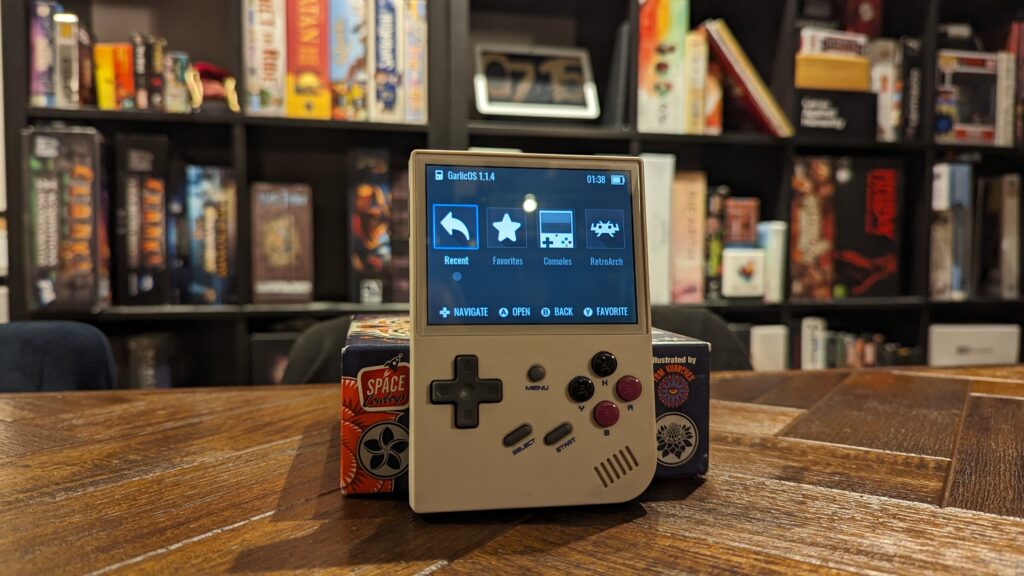
A recent project I undertook was to set up an Anbernic RG35xx, a handheld emulation device, to play retro games as there have been very few games released in the last few years that have interested me. That project, as relatively simple as it was, taught me how to use belenaEtcher to flash firmware to an SD card, much like the Raspberry Pi, how to scrape the ROM folders to pull box art, and dipped a toe into the world of affordable, low power, high performance System-On-Chip solutions. After the success with setting up and enjoying the Anbernic RG35xx, my partner and I put together another one for her brother’s birthday.
That brings us to what I am doing in an ongoing capacity and my plans for the future. At work, I was tasked with deploying and maintaining a MISP threat intelligence sharing platform instance, with a requirement for integrating the Australian Signals Directorate’s (ASD) Cyber Threat Intelligence Sharing (CTIS) threat feeds. This provides Australian businesses with Australia-specific threat intelligence for attacks that are targeting Australian businesses, as most tools, such as AlienVault, provide America-centric or Western-Europe-centric Indicators of Compromise (IOCs).
As a result of the above, as well as some other factors, at work we have deployed new on-premises hardware running a NAS like operating system (we ended up choosing UnRaid running on an SSD with a RaidZ1 on 4 spinning rust drives for mass storage), to manage parity data stored on the asset. This asset has some VMs (one of which is MISP, on a Ubuntu Server VM) and some docker containers running on it, most of which I cannot talk about. There has been a ton of last-minute-training to get it all up, running and responsive in a multi-user environment.
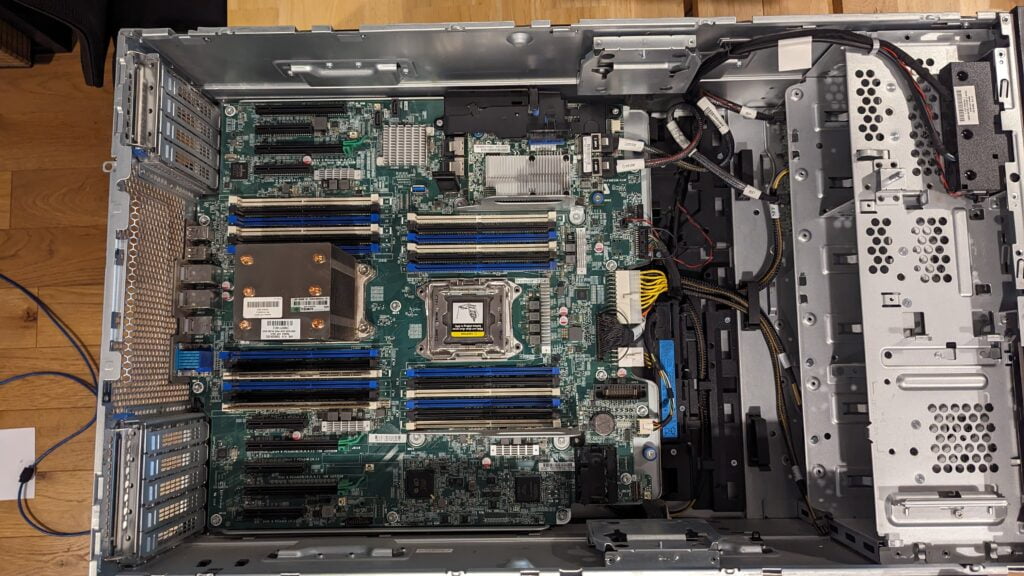
Not too long after we deployed the UnRaid system, we picked up (for the right price of free) an old HPE server, which I can talk more about as it’s not in production yet. It’s current configuration is a Xeon E5-2620v4 (8-core, 16-thread), with 32gb of Registered ECC memory running at 2400 Mt/s, two 1Tb SATA SSDs running in Raid1 for boot and two 1Tb SAS HDDs in Raid1 for bulk data. It did have a 1Tb SAS HDD as a hot spare for the Raid1 HDD array, but one of the drives died, so we have no hot or cold spare. I deployed Proxmox to the HPE server and have practically free reign to do with it what I want, with the restriction that it needs to be consciously deployed, as it is in a production environment.
The exciting part about this HPE server, is how much space for expansion we have. It has a twin socket motherboard, but only one socket is in use. The CPU in that one socket has 8 cores, and replacements/upgrades are relatively cheap. It has 8 dimms per socket, and on the socket that has a CPU, only two of the dimms are populated.
As for the future, I plan to take the learnings and experience gained in my work projects to deploy and maintain a Home-Lab. A place where I can make mistakes without them affecting business operations, and learn a lot more about the sysadmin side of things. As part of the Home-Lab, I plan to also get my hands on some prosumer/professional networking gear, Routers, Layer 2 Switches, Layer3 Switches, Firewall appliances, etc. to cut my teeth on.